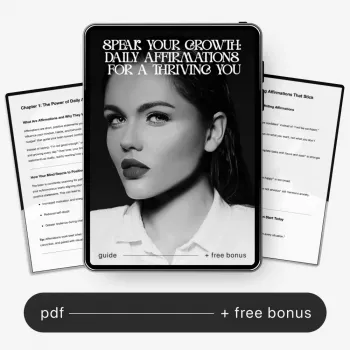
Daily Courage: AI Affirmations + Printable Workbook


Courage is rarely a single big moment—it’s a daily practice made of small, repeatable choices. A printable mindset guide paired with AI-supported affirmations helps turn that practice into a simple routine: read, reflect, respond, and track progress. This structure is designed for people building confidence, facing fear, and strengthening follow-through with steady, realistic self-talk.
What “daily courage” looks like in real life
Daily courage usually shows up as action with discomfort, not the absence of fear. It’s the choice to move forward while your body would rather avoid, delay, or stay quiet. The “brave” moment may look ordinary from the outside, but it’s meaningful because it interrupts a familiar pattern.
Common everyday courage moments include speaking up in a meeting, setting a boundary with a friend, trying again after a mistake, sending the email you’ve been postponing, or asking for help instead of pretending you’re fine. Consistency matters more than intensity: small, repeated actions teach your nervous system that you can handle discomfort and still be okay.
Affirmations support courage by guiding attention (what you focus on), shaping self-perception (who you think you are), and creating behavioral momentum (what you do next). When they’re grounded and paired with action, they can reinforce a practical identity: “I’m someone who shows up.” Research related to self-affirmation and self-efficacy helps explain why reinforcing values and capability can reduce threat response and strengthen follow-through (see self-affirmation theory and the APA definition of self-efficacy).
How AI-supported affirmations can feel more personal (and more usable)
Generic affirmations often fail because they don’t match real life. AI-supported affirmations can be tailored to situations that actually trigger fear—work visibility, relationship boundaries, health habits, creative output, or rebuilding confidence after a setback.
Personalization also helps with variety without losing focus. You can rotate themes (confidence, calm courage, resilience) while keeping language consistent enough to feel like “your voice.” On hard days, tone-matching matters: you might need gentle phrasing that lowers pressure, or firm phrasing that stops overthinking.
The most important guardrail is believability. The goal isn’t to leap from “I’m terrified” to “I’m unstoppable.” It’s a step forward that your brain can accept: “I can take one uncomfortable step,” “I can practice being direct,” or “I can stay present for 60 seconds and then decide.”
A simple daily routine using a printable workbook
A printable courage workbook makes the practice frictionless. You don’t have to remember what to do next—just follow the page: choose a statement, name one action, and capture evidence. Over time, that evidence becomes a confidence bank you can borrow from when anxiety spikes.
Daily courage practice: quick schedule
| Time | What to do | Example prompt | Time needed |
|---|---|---|---|
| Morning | Read 1 affirmation, set 1 brave micro-goal | “What is one uncomfortable thing worth doing today?” | 2–5 min |
| Midday | Repeat a reset line, take one small next step | “One step counts, even if it’s small.” | 1 min |
| Evening | Reflect and record evidence of courage | “What did I do despite fear?” | 3–7 min |
| Weekly | Review wins, adjust affirmations and goals | “What helped most when I felt resistance?” | 10 min |
Affirmation themes that build bravery and confidence
If you want courage to show up reliably, choose a theme for the week so your mind isn’t renegotiating the same decision daily.
- Taking action: statements that emphasize starting before feeling ready (momentum over mood).
- Self-trust: reinforcing follow-through and decision confidence, especially after past inconsistency.
- Boundaries: courage to say no, ask for clarity, and protect time without overexplaining.
- Visibility: showing up, sharing work, speaking in meetings, initiating conversations.
- Resilience: recovering after mistakes without self-punishment or quitting.
- Calm courage: grounding, slowing down, and choosing a wise response under pressure.
Reflection practices can amplify these themes by helping you notice progress and feel supported by your own record. Background research on reflective habits and well-being is available through the National Institutes of Health.
Making affirmations believable (so the brain doesn’t reject them)
Using the workbook during anxiety, avoidance, and self-doubt
Who this printable guide fits best
Printable use ideas and gentle accountability
Daily Courage Affirmations with AI: what’s inside and how to use it
The Daily Courage Affirmations with AI | Printable Mindset Guide | Digital Self-Growth Workbook for Building Bravery & Confidence | daily courage affirmations with ai is designed for daily use and reflection: choose a theme, write one micro-action, record evidence, and review weekly. It works well as a focused 14–30 day challenge or as an ongoing routine you return to whenever fear gets loud.
To keep the practice light and sustainable, pair your workbook with a simple place to jot quick wins or reminders—like the Am I Perfect No Spiral Notebook – Funny Notebook – Best Design Notebook. And if your courage goals involve training alone, independence, or building confidence through solo activity, Flying Solo: The Ultimate Guide to Mastering Solo Sports | A Practical Guide Exploring Solo Sports Pros and Cons for Independent Athletes can complement your mindset routine with practical structure.
FAQ
How long does it take for daily courage affirmations to make a difference?
Small shifts can show up within days when you pair affirmations with micro-actions you actually complete. Stronger confidence typically builds over weeks through consistency, reflection, and tracking evidence of effort.
What if affirmations feel fake or uncomfortable?
Use believable phrasing like “I’m learning to…” or “I can practice…” and attach each statement to one small action. Writing down proof—tiny wins, attempts, and recoveries—reduces internal pushback over time.
Can this be used for public speaking or workplace confidence?
Yes. Choose themes like visibility, boundaries, and calm courage, set a small exposure goal (ask one question, share one idea), and log what happened to build self-trust and reduce avoidance.